Showing posts with label science. Show all posts

Monday, 4 February 2013

Number 25: 'DNA' diffraction with a spring and a laser pointer

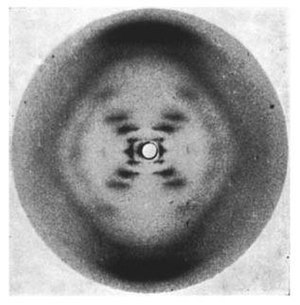
Photo 51
Time for my second DNA post and I thought I'd take a look at the data that allowed Watson and Crick to work out the famous molecule's structure.

The crucial bit of information came from a photo taken by Rosalind Franklin and Raymond Gosling.  The image is now quite famous and is known as photo 51.

But photo 51 doesn't much look like a picture of DNA. And thats because it is in fact an X-ray diffraction image taken by shining X-rays at a crystal of DNA. Its a bit of a leap from the photo to the DNA structure but luckily there's a really easy way to demonstrate how an image like this comes from a helical structure.

You'll need:
    - a retractable ball point pen
Safety:
Adult supervision required here. Be careful with the laser and don't shine it in anyone/anythings eyes.

What to do:

1) Unscrew the pen and remove the spring. The spring is of course a helix, so its going to act as our model for DNA.

2) Shine the laser through the spring, and then onto a white wall or card about 3 meters away. Best to do this at night with the lights dimmed.

You should see an image on the wall that looks a lot like this.


Which also happens to look a lot like photo 51. And that's because the same processe generates both images.

What's going on:
Both photo 51 and the cross you've just made on the wall are formed by a process known as diffraction. To explain what that is we need to remember that light is a wave.  Now imagine two waves meeting each other. If the waves overlap so that he peaks are in the same place then they combine and the result is a wave that is twice as high. But if the peak of one wave meets the trough of the other they cancel each other out, and in the case of light you get a dark spot (you can also see this happening if you shine the laser at a CD). So some of the laser light that diffracts off the spring interferes with other waves of light giving you a cross and the spots. And from the distance between the spots and the angles of the cross you can work out the shape of the spring (or DNA).

Exactly how its done is explained very nicely here.

And a hat tip to Suzie Sheehy who told me about this fab demo.

Tuesday, 30 October 2012

Number 21: Halloween slime

Halloween is almost here and so it is time for some messy mayhem! Time to roll out the classics, cornflour slime! All in funky comic book format.

I love playing with this stuff, its sooo simple and so much fun. OK it makes a bit of a mess, but it's only flour. Plus it doesn't splash, try making a big bowl of the stuff and then hitting it.

What to know more?

The cornflour water mix creates something called a non-Newtonian liquid. Basically, when you shock the liquid it turns to a solid. Ketchup is another example, that's why hitting the bottom of the bottle to get it out doesn't help much. It turns out this is really useful effect (not the ketchup), some bullet proof vests use the same principle and someone has even suggesting filling pot holes with this cornflour mix. 

Sunday, 7 October 2012

Number 20: Black Worms

Firework season (in the UK) is approaching so I thought it would be fun to find a simple homemade pyrotechnic. And here it is, 'black worms' made with stuff you're bound to have around the house.


You'll need:
  • Icing or powdered sugar (if you haven't got any already then just wizz some granulated sugar in a food processor).
  • Bicarbonate of soda
  • A pot of sand
  • An alcohol based handwash gel
  • A pot and a teaspoon
  • Matches or a lighter
Safety: 
We're using flames and flammable materials so this is best done outside and with adult supervision.

What to do:

1. Mix 2 teaspoons of icing sugar with 1/2 teaspoon of bicarbonate of soda.

2. Make a small depression in the sand and then spoon the sugar/bicarb mix into it.

3. Squirt the handwash gel all the way around the pile of the sugary mix.


4. Light the gel and watch the snakes grow!


What's going on?

The handwash gel contains ethanol which burns pretty well. This heats up the bicarbonate of soda, which gets converted to carbon dioxide, sodium carbonate and water. Meanwhile some of the sugar starts to burn i.e. it reacts with the oxygen in the air, and ends up as more carbon dioxide and water plus  a whole load of stuff that comes form sugar that didn't burn completely. This is what causes the carmel smell and black sooty stuff.  Then all that carbon dioxide forms bubbles in the caramelised sugar and sodium carbonate which causes it to rise up as those little worm like towers.

Sunday, 23 September 2012

Number 19: The greenhouse effect in a bottle

The news is full of stories about climate change and the greenhouse effect. We're told that the carbon dioxide building up in the atmosphere is resulting in the planet warming. Despite all the overwhelming evidence that our planet is heating up (just look at the amount of Arctic sea ice that melted this summer)  some people are still skeptical. And so here is a demo to prove to yourself and anyone else that wants to watch that  carbon dioxide is most definitely a greenhouse gas.


You'll need:
  • 2 x 2 litre plastic bottles (these need to be identical) and 1 smaller plastic bottle.
  • 2 thermometers.
  • 3 corks or rubber bungs, that fit snuggly into the necks of the bottles.
  • 2 lamps fitted with 100 Watt light bulbs.
  • Some vingar
  • Bicarbonate of soda
  • A length of tubing.
  • A drill


What to do:
1. Drill a hole through the middle of each cork. Then carefully push the thermometers through two of them. They need to be a tight fit. Put one of the thermometers, mounted in a cork, into one of the 2 large plastic bottles.

2. Connect up the length of tubing to the third cork. If this is proving difficult then push the empty sheath of a ball point pen through the hole and then connect the tubing to it.

3. Put the other end of the tube into the second large bottle.

4. Now take the small bottle and spoon in 3-4 teaspoons worth of bicarbonate of soda.

5. For this step you need to be quick. Pour 200ml of vinegar on top of the bicarb, then quickly push the cork thats attached to the tubing onto the bottle.  Gently swirl the vinegar/bicarb mix until it stops bubbling. 

TIP: IF you can't get the cork in quickly enough, then try wrapping the bicarb up in some toilet roll. Then push the bundle into the bottle, before pouring on the vinegar.

The bicarb and vinegar react to form carbon dioxide gas. This gets pushed up and out of the tubing into the second bottle. Carbon dioxide is denser than air so it then settles in the bottom of the large bottle.


6. Now cork the large bottle with the other thermometer.

7. Take the two lamps and put them equal distance from a bottle.

8. Turn on the lamps and watch the temperature of the bottles rise. 

9. The bottle containing carbon dioxide should get hotter quicker. I saw a 5 degree centigrade difference after about 10 minutes.
 

TIP: You need to make sure that appart from their contents the bottles are identical. Have them the same distance from the lamps and make sure the thermometers are the same depth in the bottles.

What's going on?
The gases in the bottle are transparent, that much is obvious, after all we can see through them, and we can't tell the difference between the carbon dioxide and air bottles just by looking at them. But the gasses in the bottles are only transparent to visible light.  If you could see in infrared then you'd notice that the carbon dioxide bottle blocked out more of this light than the bottle containing just air. Heat can be transferred via infrared light. So as the carbon dioxide absorbs the infrared light it heats up. And the same thing is happening to our planet.

Friday, 10 August 2012

Number 18: The bottle rocket

Rocket science isn't exactly brain surgery. A few odds and ends and a bicycle pump is all you need to build a pretty impressive rocket.

Safety first:
The rocket can take off with quite a bit of speed.

  • Make sure there is a responsible adult present.
  • Don't point the rocket towards any people or animals.
  • When you launch the rocket make sure it's pointing away from you.
  • Launch the rocket where there is plenty of space for it to come down. A playing field is ideal.


You'll need:
  • An old bicycle inner tube.
  • A cordless drill.
  • An empty soda bottle.
  • A cork or bung that fits snuggly into the bottle.
  • Sticky tape.
  • Drinking straws.
  • 4 wooden skewers.
  • A bit of thin card.
  • A pump (a foot pump or track pump will do nicely).
  • Scissors

How to build it:

1. Cut the valve out of the inner tube. Trim off the excess tubing from around the valve.


2. Drill a hole through the cork.

3. Push the valve through the hole in the cork. It needs to be a tight fit, so you might have to tap it in with a mallet.


4. Cut the drinking straw into 4 bits. Fold over one end of each bit of straw. Tape them to the bottle with the open end pointing towards the neck of the bottle. 

5. Make a nose cone from the card and tape it to the bottom of the bottle.


6. Pour water into the bottle until it's about 1/4 full.

7. Push the cork into the bottle.


8. Attach the pump to the valve.

9. Stick the skewers into the ground and slide the straws onto them  so that the rocket is resting on the skewers.


10. Make sure the rocket is pointing away from you then start the countdown and get pumping!

These are 3 successive frames from a movie shot at 30 frames per second. So you can see the rocket launches pretty quickly!

What's going on?

The physics involved here is really quite simple. The same principles apply as with the film canister rocket. In that case we had a container that filled up with gas as a result of a chemical reaction. With the bottle rocket the pressure build up is caused by you pumping air in. Eventually the pressure gets too great and the cork pops out. The air pressure then forces the water out, the action of the water moving down and out of the bottle in turn propels the bottle upwards.

It's another great example of Newton's 3rd law of motion which states: "To every action there is an equal and opposite reaction". So in this case the action is the water being forced out of the bottle, and the reaction is the rocket shooting off.


Thursday, 19 July 2012

Number 16: Cinder toffee

No, I haven't turn this into a cookery blog. There's actually loads of cool science involved in cooking and cinder toffee is a particularly interesting example, plus as an added bonus it tastes great.

You'll need:

  • Sugar
  • Golden syrup
  • A jam/jelly thermometer
  • Bicarbonate of soda
  • Grease proof paper
  • A baking tray
  • A saucepan
Safety:
The toffee mix gets very hot, be careful when handling in and make sure there's an adult helping.


What to do:

1. Weigh out 100grams (3.5 oz) of sugar into the saucepan.
2. Add 3 tablespoons of syrup
3. Heat the mixture on a stove whilst stirring it.
4. Check the temperature of the mixture.
5. Carry on heating until it reaches 145-150oC (293-302).

6. Quickly stir in 1 teaspoon of bicarb. It will suddenly bubble up. 
7. Now pour it into the baking tray, lined with grease proof paper.
8. Leave it to cool. 
9. Break it all up (best done with a hammer) and enjoy!

What's going on?


So that's a nice simple recipe for a tasty treat but where is the science?

First off there's the sugar and syrup. There are actually loads of different types of sugars, the stuff you put in your coffee and the granulated sugar used here is sucrose. It looks like this:
Sucrose

Golden syrup is a mixture of water, sucrose and two other sugars called fructose and glucose. They look like this:
Fructose
Glucose
Sucrose is actually made up of a fructose and glucose molecule that have been joined together.

So why do we need these three sugars to make the toffee? Well, when they are mixed all together they interfere with crystal formation. To explain how this works let's represent each of the sugars with a different shape. 


If we have one type of sugar then the molecules can pack together nice and neatly, like in the diagram. And that is exactly what happens in a crystal. But if you mix them all together they can't form ordered patterns and so you don't get crystals forming.

So if we tried to make the toffee with just one type of sugar then we'd end up with crystals forming which make for hard dense toffee (more like a boiled sweet). But by using 3 different sugars the crystals don't form and instead you end up with a brittle, crunchy, glass like toffee.

Then there's the bicarbonate of soda. You normally put this in cakes to make them rise. That's because when you heat up the bicarb it turns to carbon dioxide gas (hence the bubbles in your cakes). The same thing happens here (and its also almost the same reaction as in the film canister rockets). When you spoon the bicarb into the hot sugar it almost instantly gets converted to carbon dioxide and causes the mixture to foam up.

Hope you enjoy the toffee and whilst you do you can find out more about the science of cinder toffer here.

Thursday, 5 July 2012

Number 15: The 'impossible' balancing forks


Here's a trick that just looks impossible. Even when you know what's happening it just doesn't look right.


You'll need:
  • 2 identical forks
  • Cocktail sticks or toothpicks
  • A glass
  • Matches
Safety:
Matches are involved so get adult supervisions.

What to do:
1. Lock the tines of the forks together.
2. Jam a cocktail stick through between the tines of the fork so that is sticks about 1 cm out the back.
3. Pick up the forks and place the cocktail stick over the rim of the glass with the handles pointing in towards the glass. Find the spot where the forks balance. 

This already looks pretty amazing. But it gets better!

4. Now light the end of the toothpick thats pointing towards the inside of the glass. 


So what's going on?
It just looks all wrong doesn't it? But the explanation is really quite simple. Half the weight of the forks is in front of the rim of the glass and the other half is behind the rim of the glass. So everything balances nicely.   Sometimes physics just doesn't look right.

Sunday, 17 June 2012

Number 14: Elephant's toothpaste

Here's a great example of biochemistry in action.

You'll need:

  • A bottle of hydrogen peroxide. You can get this from most pharmacists. Try and get 9%, but 6% will do.
  • Dried baker's yeast.
  • Washing up liquid.
  • An empty plastic bottle (500ml or so).
  • A glass with a 20ml of water in it.
  • A teaspoon.
Safety: 
Hydrogen peroxide is a mild bleach (which is why its used to make your hair go blond). Be careful with it and don't get it in yours eyes. Best get some adult supervision for this one. And it makes a bit of a mess so do it outside.


What to do.

1. Put about 2 teaspoons of yeast into the glass with the water. Mix it about until it looks like brown muddy water.
2. Squirt about 2 teaspoons of washing-up liquid into the plastic bottle.
3. Pour 50ml of hydrogen peroxide onto the washing-up liquid.


4. Pour the yeasty water into the plastic bottle. Stand back and ...


What's going on?
Remember the chemical formula for water? H2O, meaning water is made from two hydrogens and one oxygen. Well hydrogen peroxide is almost the same except its got an extra oxygen, so its formula is H2O2. But whilst water is very stable (remember how we needed to put electricity through water to break it down in the hydrogen and oxygen), hydrogen peroxide is unstable, it slowly decomposes to water and oxygen. However when the yeast is added to the hydrogen peroxide that extra oxygen gets released really quickly and you end up with loads of oxygen gas (the washing up liquid is just there so that the gas gets trapped in all that foam). 

So why does adding yeast result in the oxygen being released so quickly? Well yeast contains an protein called catalase. It looks like this. 
Catalase is a type of protein called an enzyme. Enzymes1 speed up specific chemical reactions. In this case the reaction is:

2 H2O2 → 2 H2O + O2
Which is just a way of saying that 2 hydrogen peroxide molecules turn into two water molecules plus 1 oxygen molecule. The really astonishing thing about catalase is how fast it works. One catalase molecule can break down 40 million molecules of hyrodgen peroxide every second!

1 The word enzyme comes from the greek ενζυμον, meaning "in yeast". Plus things that speed up chemical reactions are called catalysts, hence the name catalase. So if you follow the etymology of these things you end up going around in circles.


Friday, 15 June 2012

The Geeks are Coming

Something a bit different for this post. No instructions on fun science experiments I'm afraid. Instead I want to recommend a book that everyone who loves science should read. It's called "The Geek Manifesto: Why Science Matters" (by Mark Henderson) and its a bit of a call to arms for scientist and science lovers everywhere. Amongst other things it describes how poorly scientists are represented in politics. In the UK just one (out of 650) of our Members of Parliament had a career in science before entering politics (and its not better in the USA). Consequently politicians fail to understand how science is conducted leading, amongst other things, to a systematic abuse of evidence to support their policies. 

But this evidence abuse and misunderstanding of the scientific method is not all their fault. Scientists too often fail to engage with politicians (and the media). So Mark calls for scientist to do just that, help support politicians, talk to them and make science (and evidence based policies) a vote winning issue.

One of the book's fans, Dave Watts, took Mark's message to heart. He thought that our politicians should read the book so he rallyed the troops and via an online pledge site got scientists to agree to send a copy of "The Geek Manifesto" to every MP in the UK parliament. With the help of the publishers (Transworld, who agreed to match the individual pledges)  the target has been reached and books are winging their way to MPs right now.

I joined in the fun and have sent a copy to my MP with the following accompanying letter.

Dear Graham, 
Within the next few days you should receive a copy of “The Geek Manifesto: Why Science Matters” by Mark Henderson (Head of Communications at the Wellcome Trust)  I hope you enjoy reading it. 
A few years ago we engaged on the Royal Society’s Scientist/MP pairing scheme. I found it a most useful insight into the workings of government and the role that science can play in the decision making process.
Unfortunately and despite excellent schemes, like those run by the RS, it seems to me, and many others, that science is greatly undervalued and misused in British politics. Many of our decision makers are unfamiliar with the scientific methods and how it can be applied to policies. 
This lamentable state is in no small part due to scientists’ failure to engage with politicians. But this is changing. In recent years scientists have started to form lobby and pressure groups to better make their cases heard. 
Mark Henderson’s book follows in this vein. It is acting as a call to arms, rallying scientists and persuading them to make science and evidenced based decision an electoral issue. Therefore many of us consider “The Geek Manifesto” to be an extremely timely and important book. It contains arguments that all rational thinkers should consider. With this in mind hundreds of scientist around the country have pledged to buy and send their MP a copy of the book.  Within the next few weeks every MP should receive a copy. 
I hope you and your colleagues find the book to be an interesting read. 
An offer to help
I know from my experience on the scientist/MP pairing scheme that you are a extremely busy working to help you constituents.
In turn I believe that scientists must do more to help their MPs understand science and the scientific method. I would therefore like to offer my services in helping to form evidence based views and decisions.
My specialist expertise lies in chemistry and biochemistry. However my scientific skills are highly transferable, after all science is more about asking rational questions, solving problems and understanding date than it is learning facts and figures.
Meet the  Geeks  
Lastly, I would like to draw your attention to your local  “Café Scientifique” (details attached); a monthly meeting were local scientists talk, in an informal, setting to members of the public. You are welcome to come to our meetings, which would be an excellent opportunity for you to meet some of your ‘geek’ constituents.
I look forward to your reply, which I will post on my blog www.t2ah.com . 
Sincerely,  
Dr Mark Lorch

I'll keep you posted on any reply. In the mean time you can read more about the book and the pledge on blogs here and here and many others. And of course I heartily recommend reading the book.