Showing posts with label DNA. Show all posts

Tuesday, 26 March 2013

Number 27: Genetic Code Jewellery

Right, lets make genetic code jewelry that spells out your name. Or if you don't fancy that use if for sending secret messages!

But first I need to explain what the genetic code is.

DNA is the code for life, right? But what does that really mean? Well DNA actually contains the instructions that tells cells how to make proteins. And proteins are nature's mini-machines that make all living things work. They are like tiny robots that are involved in just about everything that goes on in your body. There are proteins that digest food, others that fight diseases and some that help make other proteins. Not only that but they hold your body together; skin, hair, muscles, cartilage and ligaments are all made from protein.

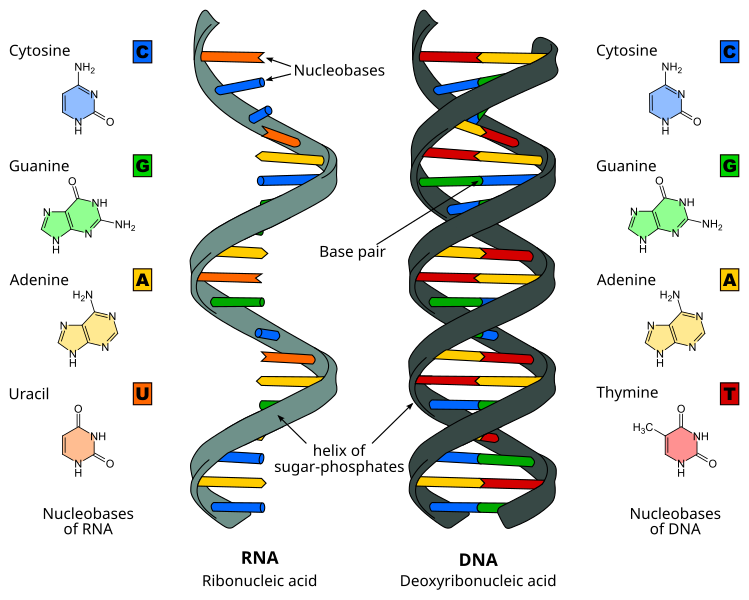
So all the information on how to make proteins is contained in DNA. This information is written as a string of 4 bases called adenine, thymine, guanine, and cytosine which are abbreviated to A, T, G and C.
RNA vs DNA


Now proteins are made up of stings of 22 possible amino acids, which are also abbreviated to single letters codes.

Amino acids and their 3 letter and 1 letter codes


So how does the 4 letter code of DNA get translated into a 22 letter code of proteins?

First off the DNA gets transcribed into RNA (which is like DNA but it is sometimes single stranded instead of double stranded like DNA, and secondly it has uracil (U) instead of thymine (T)).

To work out what protein sequence the RNA codes for you need to read it in groups of three bases. For example the sequence AUGGGAGGG would get split up into AUG GGA GGG. Each of these groups of three bases are called codons and each codon represents an amino acid. You can work out which amino acids a sequence codes for using the genetic code in this table.
The Genetic Code (click for a bigger version)
So AUG codes for M, GGA codes for G and GGG also codes for G. 

In the genetic code table there are 25 letters (X is missing) so we can spell stuff out using codons instead of the full alphabet.

How we've got that sorted lets make the jewellery.

You'll need:


What to do:

1) First decide what you want to spell out using the code. How about starting with your name?

2) Now figure out what codons you need to spell out your name.

So in my case I want to spell out 'Mark'. So I need the codons AUG GCG AGA AAA. 

3) Next select the coloured beads that represent the bases. So AUG is blue, red, yellow. The GCG is yellow, green, yellow.


4) Finally thread the beads onto the string in that order. Tie it off and hey presto a bracelet with your name spelt out in the genetic code.


FAQs.

Why are there more codons than amino acids?
There are 4 bases and codons consist of 3 bases. So that makes 64 possible codons. But there are only 22 amino acids (and in most organisms there are actually only 20). Which means that there are loads more codons than amino acids. This means that there are some spares, which turns out to be quite handy, because its suppresses the effects of mutations. For example, if ACC got mutated into ACG it wouldn't make any difference because they both code for the same amino acid.

Why do some codons say 'STOP'?
Genes always end in a STOP codon. It signals the end of a protein, its sort of like the full stop at the end of a sentence. If you fancy it put a STOP at the end of your sequence.

Why do some STOPs have have U or O after them?
U and O are the two rare amino acids. Most organisms don't use them. But when they do crop up they code for U and O instead of STOP.

How come some of the codons have two letters after them?
22 of the letters represent individual amino acids. Plus there's Z, B and J which are used for some of amino acids that are quite similar. So if a biochemist isn't sure if she's got a I or a L in her protein then she'll write down J.

I've got an X in my name what do I do?
You'll have to cheat, maybe use one of the stop codons instead.

Sunday, 10 March 2013

Number 26: Jelly Baby DNA

A couple of weeks ago I showed you how to build a passable model of DNA with K'nex. Now for something tastier.

You'll need:

What to do:

1) Sort the jelly babies into colours. Keep four of the groups and eat the rest.


2) Pair up the jelly babies so that one colour always goes with another. e.g. red with green and yellow with purple.


3) Stick the pairs onto a cocktail stick like you are making mini-jelly baby kebabs.


4) The attach the jelly baby kebabs to the long sweets. Carry on doing this until you have something that looks a bit like a ladder.


5) Pick up your ladder and give it a twist.


Hey presto a model of DNA made from sweets!

So what does it all mean?

DNA contains the information needed to build a living thing. That info is recorded in the form of four bases called adenine, thymine, guanine and cytosine (usually abbreviated to A,T,G and C). In my  model each of the coloured jelly babies represent one of these bases. So lets say yellow is A, purple is T, green is G and red is C. In DNA the base T always pairs up opposite A, whilst C pairs with G. And to represent that I  paired yellow with purple and green with red. 

The DNA molecule then twists up to form a cork screw like (helical) shape, hence the twist I gave it at the end.

Our model of DNA represents just a tiny fragment of a real DNA molecule. In reality DNA could be billions of bases long (and I couldn't get hold of that many jelly babies).

Monday, 4 February 2013

Number 25: 'DNA' diffraction with a spring and a laser pointer

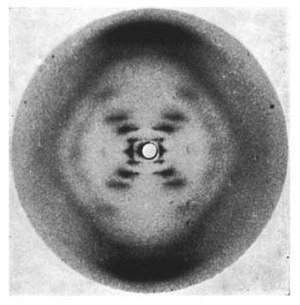
Photo 51
Time for my second DNA post and I thought I'd take a look at the data that allowed Watson and Crick to work out the famous molecule's structure.

The crucial bit of information came from a photo taken by Rosalind Franklin and Raymond Gosling.  The image is now quite famous and is known as photo 51.

But photo 51 doesn't much look like a picture of DNA. And thats because it is in fact an X-ray diffraction image taken by shining X-rays at a crystal of DNA. Its a bit of a leap from the photo to the DNA structure but luckily there's a really easy way to demonstrate how an image like this comes from a helical structure.

You'll need:
    - a retractable ball point pen
Safety:
Adult supervision required here. Be careful with the laser and don't shine it in anyone/anythings eyes.

What to do:

1) Unscrew the pen and remove the spring. The spring is of course a helix, so its going to act as our model for DNA.

2) Shine the laser through the spring, and then onto a white wall or card about 3 meters away. Best to do this at night with the lights dimmed.

You should see an image on the wall that looks a lot like this.


Which also happens to look a lot like photo 51. And that's because the same processe generates both images.

What's going on:
Both photo 51 and the cross you've just made on the wall are formed by a process known as diffraction. To explain what that is we need to remember that light is a wave.  Now imagine two waves meeting each other. If the waves overlap so that he peaks are in the same place then they combine and the result is a wave that is twice as high. But if the peak of one wave meets the trough of the other they cancel each other out, and in the case of light you get a dark spot (you can also see this happening if you shine the laser at a CD). So some of the laser light that diffracts off the spring interferes with other waves of light giving you a cross and the spots. And from the distance between the spots and the angles of the cross you can work out the shape of the spring (or DNA).

Exactly how its done is explained very nicely here.

And a hat tip to Suzie Sheehy who told me about this fab demo.

Tuesday, 22 January 2013

Number 24: K'nex DNA


60 years ago James Watson and Francis Crick were busy trying to figure out the structure of DNA.  So to celebrate the anniversary I thought I'd come up with a series of DNA related activities.

Watson and Crick eventually worked it out the structure by building models of the molecule and comparing them to X-ray pictures collected by Rosalind Franklin.

Watson and Crick built their model from bits of lab equipment and other odds and ends. You can see just how cobbled together it is if you visit  London's Science Museum. Which just goes to show that even Nobel prize winners use whatever they have to hand.

The model shows that DNA is made from two intertwined helices. Sort of like two corkscrew shapes wound around each other. Each helix is made from a backbone of sugar-like molecules bound to phosphates. Then each helix is zipped up to its partner via something called basepairs.

So what else could we use to build a model of DNA? How about K'Nex?


You'll need:

A load of these three K'nex peices (or similar)


These will represent the 3 main parts of DNA. The green pieces are going to be the sugars, the white bits are the phosphates and the blue ones are the base pairs.

To make 1 complete turn of K'nex DNA you'll need 14 green bits, 14 white and 7 blue bits.

What to do.

1) Connect up the 3 green pieces with the 3 white pieces and then 3 green pieces with 4 white pieces, so you have two sections that look like this.


2) Add the blue pieces onto the green pieces, like so.


3) Here's the tricky bit. Connect up the blue pieces to the other section like this.


You should end up with a twisted bit of k'nex model that is starting to resemble the double helix of DNA. 

4) Now just continue to build more of the same and link them together to form as long a strand of k'nex DNA as you can!

The model you've built isn't quite accurate but its still shows some of the important features of DNA. Most importantly it's a double helix  and you might notice that it's also got grooves running around the double helix. One of these is narrower than the other. These are known as the minor and major grooves , DNA has them as well.


If you want to do more DNA related stuff with K'nex you can buy the official model kit or have a look at this great site from Mount Sinai University.


Tuesday, 13 March 2012

Citizen science: Phylo the sequence alignment game

Citizen science in the form of computer games are coming think and fast. Phylo is the latest offering and I've got to say its pretty additive.

Phylo, match up the coloured blocks, score points, help scientist fight diseases!
This time the aim is to help scientist who study genomes match up the DNA in the genes from one species with those of another species. The is important because if a gene is more or less the same in many different species then it probably means that its particularly important.

So how come scientist don't just let computers work it all out? Well it turns out that computer programs are pretty rubbish at this sort of problem because they painstakingly work through all possible ways to align the bits of DNA and that takes ages. But the human brain is really good at spotting patterns, so we get the job done much more efficiently. Have a go at the game and you'll soon find you are scoring better than the computer.

The game is really quite simple, each building block of the DNA (remember those A,T,G & Cs) are represented by a different colour block. All you have to do is slide the blocks around and get the colours on one line to match up with colours on another line. You get points for every match and points taken away for incorrect matches or gaps.

The other really nice thing about Phylo is that you can enjoy it for its own sake. You don't have to know a thing about DNA, genes or genomes to be able to play it. So literately anyone can have a go.

If you'd like to read more you can find the original journal article here.