Remember those pinhole cameras I made back in June? Well they've been stuck to the side of a railway bridge since midsummer and since today is the winter solstice (in the northern hemisphere) it's time to take them down.
One camera went missing, another is was full of water. But the remaining two gave some nice images.
And here's a quick look at the results.
Has anyone else got any winter solstice solargraphs to show off?
Biological washing powder contains several types of proteins called enzymes. These are naturally occurring molecules that all living things produce to do particular jobs. They are, if you like, nature’s molecular machines. There are enzymes that digest food, fight infections and replicate DNA. You name a biological process and enzymes are probably involved in it. That’s why the washing powders that contain them are ‘biological’.
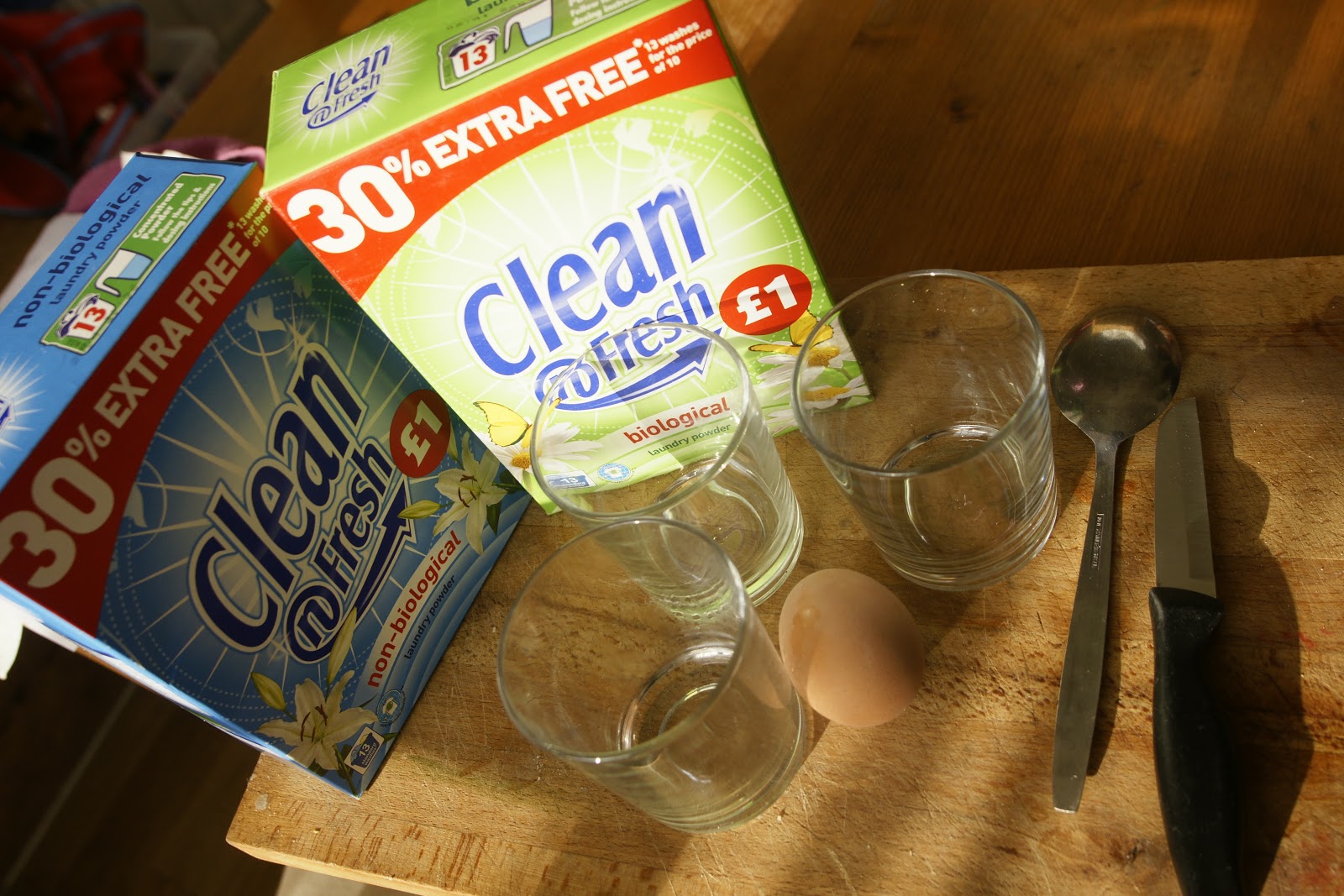
The enzymes that are added to washing powders are like molecular scissors that chop up fats, starch and proteins, all of which cause stains on your clothes. The result is cleaner clothes without needing to use hot washes (because the enzymes work at low temperatures). Its quite easy to see these enzymes in action with a nice simple demonstration using a hard boiled egg. You'll need
A hard boiled egg
2 or 3 glasses or jars
A knife
A teaspoon
Biological washing powder/liquid
If you are in the UK you can also buy non-biological washing powder (non-bio is only available in the UK because people here think it causes eczema, it doesn't).
What to do
1) Half fill the glasses with water and then mix in 1 teaspoon of biological washing powder/liquid into the first glass. If you have it add 1 teaspoon of the non-bio powder/liquid into the second glass. And leave the third glass with just water in it.
2) Chop the egg white into small pieces.
3) Place each piece in one of the glasses.
4) Leave the glasses in a warm place (like on a radiator or airing cupboard) overnight.
5) Inspect the bits of egg the next morning.
You should notice that the egg in the water and the non-bio mixture hasn't changed, it still has nice sharp edges where you made the cuts. But the egg in the biological mixture is smaller and the edges are much smoother.
The bits of egg after sitting in the glasses overnight.
What's going on?
One of the enzymes in the washing powder is known as a protease. It's a protein molecule that cuts up other proteins, some of which cause stains. But in this case the egg white, which is mainly protein, gets slowly digested by the protease. The result is a smaller bit of egg white.
I'm a big fan of proteins, they're fabulously intricate, beautiful structures that have evolved the perfect shapes and features required to do their jobs. And so I thought I'd share some of that wonder with you. This is what the protease in your washing powder looks like and (in part) you have it to thank for those nice clean pants.
What do you need to make stuff burn? Just three things, oxygen, a energy source to get it all started and some fuel. These three things are there every time you light a candle or start the engine of a car. The candle wax (or petrol) is the fuel, the match (or a spark) gets is all started and the whole thing is kept going with the oxygen in the air.
So what else can we get to burn? How about steel?
Steel is mostly iron mixed with some carbon and sometimes, other metals (depending on what the steel will be used for) and its not something you'd normally think burns.
Some old tiles or something similar that you don't mind getting scorched.
Safety
This reaction generates a lot of heat (chemists call it an exothermic reaction) and can throw out sparks so make sure there is nothing near by that might catch fire. Have a bucket of water or fire extinguisher handy. You can also end up with some small particles of steel wool being chucked up and you don't want to get them in your eyes, so wear safety goggles. Make sure there is a responsible adult supervising. Finally, because you get some smoke and sparks produced you should do this outside, you don't want to set fire to the kitchen.
What to do:
1. Fluff up the steel wool a bit. This is to make sure there is plenty of air in amongst it all.
2. Put the wool on the tiles (or whatever it it you are using)
3. Touch the terminals of the battery to the wool.
Almost instantly you'll see part of the wool glowing red hot, very quickly this spreads through the whole clump of wool, consuming it all. Like this:
What's going on:
When you burn things with carbon in them (these are known as organic compounds), like candle wax or fuel in the car, you are reacting the carbon with oxygen to make carbon dioxide gas (which has the chemical formula CO2 meaning 1 carbon and 2 oxygens). But in this case there isn't any carbon to burn nor are we lighting anything with a flame. Instead the electricity from the battery runs through the steel wool and heats it up. This happens because the electrons and ions that form the electricity collide with other particles that make up the steel wool making them move around, and heat is just the result of particles (like atoms) moving.
The heat speeds up the reaction between the iron in the wool and the oxygen in the air. This would happen anyway, without your help, just much slower (that's why things rust). And this reaction produces heat (its exothermic) which kept the reaction going until you run our of fuel (i.e. the steel wool).
When you burn candles or wood you don't end up with much left over. That's because carbon dioxide is a gas, so it floats away. But when you burn steel wool you end up with iron oxide which is a solid, hence the black stuff that's left over. One more thing, the chemical formula the iron oxide is Fe2O3 ie. 2 iron atoms (which have the chemical symbol Fe) react with 3 oxygens.
Christmas is fast approaching so what will geeks be asking for this year? I suggest that any science lover (young or old) worth his/her salt defiantly needs a copy of "A Neutron Walks Into a Bar ".
This fact packed book has more authors that you can shake a stick at as it's a compilation of sciency tweets that populated the twitterverse earlier this year.
A group of scienceophiles from Dublin hit upon the idea of setting twitter the daily challenge of spouting forth its favourite science facts on a given subject. And so spring 2012 was filled with the daily onslaught of a fascinating and heady mixture of jokes, quotes and quips (all in under 140 characters). Subjects ranged from maths (A googol is 1 followed by 100 zeros. 1 followed by googol zeros is a googolplex. Google's headquarters is the googleplex) to magnetism (Pigeons navigate using magnetoception via a mineral embedded in their brains called magnetite) from the particle physics (There are 6 types of quarks, known as flavours: up, down, strange, charm, bottom and top) to poetry (Darwin spoke of evolution, And brought with it revolution, Wallace, too, found the solution, We must not forget his contribution).
The result is a wonderful book (and I'm proud to have contributed to it) from which anyone and everyone can learn a thing or 2 (thousand).
If I didn't have a copy already I'd defiantly be asking for one in my stocking.
Halloween is almost here and so it is time for some messy mayhem! Time to roll out the classics, cornflour slime! All in funky comic book format.
I love playing with this stuff, its sooo simple and so much fun. OK it makes a bit of a mess, but it's only flour. Plus it doesn't splash, try making a big bowl of the stuff and then hitting it.
What to know more?
The cornflour water mix creates something called a non-Newtonian liquid. Basically, when you shock the liquid it turns to a solid. Ketchup is another example, that's why hitting the bottom of the bottle to get it out doesn't help much. It turns out this is really useful effect (not the ketchup), some bullet proof vests use the same principle and someone has even suggesting filling pot holes with this cornflour mix.
Firework season (in the UK) is approaching so I thought it would be fun to find a simple homemade pyrotechnic. And here it is, 'black worms' made with stuff you're bound to have around the house.
You'll need:
Icing or powdered sugar (if you haven't got any already then just wizz some granulated sugar in a food processor).
Bicarbonate of soda
A pot of sand
An alcohol based handwash gel
A pot and a teaspoon
Matches or a lighter
Safety:
We're using flames and flammable materials so this is best done outside and with adult supervision.
What to do:
1. Mix 2 teaspoons of icing sugar with 1/2 teaspoon of bicarbonate of soda.
2. Make a small depression in the sand and then spoon the sugar/bicarb mix into it.
3. Squirt the handwash gel all the way around the pile of the sugary mix.
4. Light the gel and watch the snakes grow!
What's going on?
The handwash gel contains ethanol which burns pretty well. This heats up the bicarbonate of soda, which gets converted to carbon dioxide, sodium carbonate and water. Meanwhile some of the sugar starts to burn i.e. it reacts with the oxygen in the air, and ends up as more carbon dioxide and water plus a whole load of stuff that comes form sugar that didn't burn completely. This is what causes the carmel smell and black sooty stuff. Then all that carbon dioxide forms bubbles in the caramelised sugar and sodium carbonate which causes it to rise up as those little worm like towers.
The news is full of stories about climate change and the greenhouse effect. We're told that the carbon dioxide building up in the atmosphere is resulting in the planet warming. Despite all the overwhelming evidence that our planet is heating up (just look at the amount of Arctic sea ice that melted this summer) some people are still skeptical. And so here is a demo to prove to yourself and anyone else that wants to watch that carbon dioxide is most definitely a greenhouse gas.
You'll need:
2 x 2 litre plastic bottles (these need to be identical) and 1 smaller plastic bottle.
2 thermometers.
3 corks or rubber bungs, that fit snuggly into the necks of the bottles.
2 lamps fitted with 100 Watt light bulbs.
Some vingar
Bicarbonate of soda
A length of tubing.
A drill
What to do:
1. Drill a hole through the middle of each cork. Then carefully push the thermometers through two of them. They need to be a tight fit. Put one of the thermometers, mounted in a cork, into one of the 2 large plastic bottles. 2. Connect up the length of tubing to the third cork. If this is proving difficult then push the empty sheath of a ball point pen through the hole and then connect the tubing to it. 3. Put the other end of the tube into the second large bottle. 4. Now take the small bottle and spoon in 3-4 teaspoons worth of bicarbonate of soda. 5. For this step you need to be quick. Pour 200ml of vinegar on top of the bicarb, then quickly push the cork thats attached to the tubing onto the bottle. Gently swirl the vinegar/bicarb mix until it stops bubbling. TIP: IF you can't get the cork in quickly enough, then try wrapping the bicarb up in some toilet roll. Then push the bundle into the bottle, before pouring on the vinegar. The bicarb and vinegar react to form carbon dioxide gas. This gets pushed up and out of the tubing into the second bottle. Carbon dioxide is denser than air so it then settles in the bottom of the large bottle.
6. Now cork the large bottle with the other thermometer.
7. Take the two lamps and put them equal distance from a bottle.
8. Turn on the lamps and watch the temperature of the bottles rise.
9. The bottle containing carbon dioxide should get hotter quicker. I saw a 5 degree centigrade difference after about 10 minutes.
TIP: You need to make sure that appart from their contents the bottles are identical. Have them the same distance from the lamps and make sure the thermometers are the same depth in the bottles. What's going on?
The gases in the bottle are transparent, that much is obvious, after all we can see through them, and we can't tell the difference between the carbon dioxide and air bottles just by looking at them. But the gasses in the bottles are only transparent to visible light. If you could see in infrared then you'd notice that the carbon dioxide bottle blocked out more of this light than the bottle containing just air. Heat can be transferred via infrared light. So as the carbon dioxide absorbs the infrared light it heats up. And the same thing is happening to our planet.




 1. Drill a hole through the middle of each cork. Then carefully push the thermometers through two of them. They need to be a tight fit. Put one of the thermometers, mounted in a cork, into one of the 2 large plastic bottles.


