You know that noise a siren makes as it goes whizzing past atop of an ambulance or police car? As it approaches you the pitch of the siren changes. This is due to something we call the Doppler effect. But you don't have to wait for an emergency vehicle to hear it in action...
All you need is:
A length of string
A kitchen timer
What to do:
1) Securely tie the string to the timer (Double check this, you don't want the timer flying around later)
2) Start the timer beeping.
3) Find a nice big open space and swing the timer round your head in a big circle.
Notice anything odd about the sound of the beeper?
Well you shouldn't, because if you are doing the swinging then the distance between you and the timer isn't changing, so you won't hear a change in pitch. Just like you wouldn't notice the sound of the siren changing if you were sitting in the emergency vehicle.
However if you get someone else to listen (watch out they don't get hit by) , then they'll hear a different note depending on whether the timer is coming towards them or swinging away.
What's going on?
Sound travels as waves, and the pitch of note depends on how close together the peaks of these waves are. So a high note will be made of waves with peaks that are closer together that a low note.
The timer is emitting a constant beep with a constant note i.e. the distance between the peaks of the waves are always the same. But when the timer is travelling towards an listener (i.e. not the person doing the spinning) each wave peak is emitted from a point that is closer to the listener than the previous peak. Therefore the time between each peak arriving at the listener is reduced and so the note sounds higher. Then the reverse happens when the timer is moving away from the listener and the note sounds lower.
And of course the person doing the spinning doesn't notice any change because the distance between him and the timer doesn't change.
In my last post I posed a question: Does rubbing your hands on stainless steel gets rid of garlic smells? There's clearly plenty who believe it does, you can even buy stainless steel 'soap'
.
Varioustheories as to how steel may achieve this were posited. But I wanted to know if there was a real effect in the first place.
Kitchen chemists everywhere helped answer this by taking part in a stinky citizen science challenge. And the results are, well, interesting.
I asked people to conduct a quick experiment whilst prepping dinner. The task was simply to rub the palms of their hands with garlic. Then treat one hand with a wipe from a stainless steel spoon and the other with a wooden spoon. Finally participants asked some other poor soul to take a sniff of their hands and report on whether there was a discernible difference.
Thanks to everyone who took up the garlic challenge (especially the person who did their experimenting whilst cooking Christmas dinner).
And so to the results.
These were collected via surveymonkey, with the question "Which hand smelt more of garlic?" and the answer choices a) The hand rubbed with the wooden spoon, b) The hand rubbed with the stainless steel spoon, c) Couldn't tell the difference.
44 allium lovers responded. Of those 17 thought the hand treated with the wooden spoon smelt more garlicky, 6 said the stainless steel treated hand was the stinkier. So far, so good. Looks like the stainless steel effect might be real. But here's the rub, there's still the other 21 responses, none of whom could tell the difference between the smelly hands.
So we've got results that are significantly different from an even distribution between the options (the two-tailed P value equals 0.0163 ,according to a chi squared test). However, the stainless steel treatment seems to be only about 38% effective, assuming the wooden spoon is a good negative control. But maybe the abrasive, absorbent wooden spoon is also quite good at removing garlic smells? In which case the effectiveness of the stainless steel is an underestimate.
Oh well, sorry people, but it looks like I can't really offer a definitive answer. In hind sight I think the experimental design could have been better. A before and after spoon treatment sniff test would have been a good idea. And maybe a better negative control was in order.
Is another round of experiments could be in order?
@suziesheehy Good question! From memory, garlic odour comes from allyl methyl sulfides. Presumably the sulfide part reacts with a component
— Dr Suze Kundu (@FunSizeSuze) October 15, 2013
But before we get to the 'how' question maybe we should figure our if there is any truth in the anecdotes.
So how about an experiment? And I'll be needing your help for this one.
You'll need
A clove of garlic.
A knife.
A timer.
A wooden spoon and a stainless steel table spoon of about the same size.
What to do
1. Wash and dry your hands (so they don't smell of anything to start with).
2. Cut the clove of garlic in half (don't peel it, that way your fingers won't pick up garlic smells when you hold it).
4. Rub the freshly cut surface on the palm of one hand for 10 seconds (use the timer).
5. Rub the second piece of garlic on the palm of your other hand for 10 seconds (this way each hand gets rubbed with a fresh piece of garlic of the same size).
6. Rub one palm with the back of the stainless steel spoon and the other palm with the wooden spoon (the wooden spoon is our control experiment). Again for 10 seconds each. Make sure you remember which hand was rubbed with which spoon.
7. Find a willing volunteer, ask them to close their eyes (with their eyes closed they are less likely to notice any signals from you about which hand has had what treatment).
8. Hold a hand under their chin (that way each hand will be the same distance from the test subjects nose) and ask them to smell it. Then do the same with the other hand.
8. Ask them which hand smelt stronger of garlic.
9. Let me know the results using the survey below. We'll need plenty of tests if we are going to be sure of our results, otherwise it's just more anecdotes.
I'll get back to you with a conclusion when enough results are in.
Create your free online surveys with SurveyMonkey , the world's leading questionnaire tool.
What colour is chlorophyll? Obviously its green. After all chlorophyll is the pigment in leaves that absorbs the Sun's rays in the first step of photosynthesis. It reflects the green light which is why the leaves are that colour. But what colour is chlorophyll under UV light?
You'll need.
Some green leaves, spinach works well.
A pestle and mortar
A clear spirit like gin or vodka (best to ask an adult before using this)
Gently mash it all up with the pestle until the chlorophyll dissolves in the alcohol and the liquid goes green.
Filter the bits out of the chlorophyll extract by pouring it through some kitchen roll and into a glass.
Now shine the UV light through your green liquid. You'll notice that where the UV light passes through the chlorophyll extract a reddish light is emitted.
What's going on?
Chlorophyll fluoresces, this means that it absorbs light of one colour and emits it as another. So in this case the UV light gets converted into red light by the chlorophyll. You wouldn't notice this effect in leaves because the chlorophyll is bound up with a huge amount of protein machinery that the plant needs for photosynthesis. These proteins take the energy emitted by the chlorophyll and pipe it into complex pathways that result in the plants using the suns energy to grow. But strip away the proteins, using some alcohol, and that energy gets emitted as red light instead.
My Guardian post is meant as a parody of the Buzzfeeds article that I linked to at the top of the piece. I thought it was explicit enough to make that clear, however this doesn't appear to be the case.
My only intent was to show how, with the wrong spin, you can make anything sound dangerous.
So in case things still aren't clear.
1) E290 is just carbon dioxide. We breath it out all the time and is safe to consume in foods.
2) 8-methyl-N-vannillyl-6-noneamide is also know as capsaicin. It generates the 'heat' in chilli peppers and spice food. Riot police also use it a tear gas.
3) Denatured proteins in eggs don't cause any diseases.
4) DHMO or dihydrogen monoxide is just water
5) NaCl, as many have pointed out is table salt. The fact that both sodium and chlorine are dangerous is irrelevant.
6) And uranium oxide has long been used to make green glass. It too is perfectly safe.
You can get hold of it really quite easily and better still it really does glow in the dark!
I'm actually talking about uranium oxide, not the metal itself. And you find it in some green glassware, were it gives a lovely minty colour. You might even have some at home without realising it.
Its easy to check if green glass contains uranium oxide because it fluoresces under UV light. Here's a bowl I bought for £5 under normal light and then under UV.
If you want to hunt some of this really cool (and slightly radioactive) glassware out then get yourself an ultra violet keyring torch and check out green glass you come across in carboot sales, charity shops and antique markets.
Safety:
Fear not, uranium glass is safe. In fact when I ran a Geiger counter over this piece I couldn't measure anything above background radiation levels.
There may be a mild concern if you happen to have a large collection. But a small number of pieces is certainly nothing to worry about.
P.S. The ratio of uranium and oxygen in uranium oxides follows Fibonacci ratios i.e. U2O5, U3O8, U5O13, U8O21, U13O34 ! Anyone care to explain why?
Remember the Geek Manifesto? It's a great book by Mark Henderson that calls for a more evidence based approach to politics and decision making. I reviewed it last year, so I won't go on about it in any more detail now.
Did the politicians read it? What did they thing of it? Has it made a difference? I thought it was about time we found out. So I've just written a piece for the Guardian urging people to write to their MPs and AMs and get some feedback on the book.
When you get a response email (havetheyreadit.gmail.com) or tweet (@sci_ents) me a copy of the MP's letter. I'll collate them (and make them freely available to everyone) then I'll get back to you with a summary of their responses.
If you want to join in then feel free to crib the letter I'm sending to my MP.
Dear Graham,
Last summer I sent you a copy of Mark Henderson’s book The Geek Manifesto, Why Science Matters. Every
other Member of Parliament and the Welsh Assembly also received a copy, either
from a constituent or Transworld books.
The book, as I’m sure you are aware, deals with the links between
science and politics, how policy makers abuse evidence and how science could be
managed to greater effect. It also suggests ways that more evidence based policy
might be formulated. Plus it also calls on geeks everywhere to get involved in
policy and to engage with their representatives by offering up their expertise.
I would very much like to know what our representatives thought of
the book. Have you had time to read it? Did it strike a chord? Has it been a
subject of discussion with your colleagues? How has it affected the way you
formulate policy and your views of science/scientists?
You may also like to know that I have written a piece for the Guardian asking others to contact their
MPs and AMs with similar questions. I intend to collate responses and report on
them in a follow up piece in the Guardian.
This open letter will appear on by blog (www.t2ah.com)
and I will also post a copy of your reply.
I look forward to your reply.
Yours sincerely
Mark Lorch
UPDATES: 13 replies Unread: 7 Partially read: 3 Read it: 3
First reply in! From Justin Tomlinson MP.
Thank you for your email.
Yes I was sent a copy of the ‘Geek Manifesto’. I am afraid I haven’t yet read it (I am sent several books a week from various campaign groups) however I have kept it to read as I get chance.
I believe Parliament would be better served with more people from a Science background, as we also need with many other professions.
Kind regards, Justin
Tim Farron's read some of it, mainly before science debates.
Thank you for your reply. No, I have not read the book. But I certainly agree with the concept that decision-making should be based on evidence and science.
Stephen Williams has it on his bookshelf but hasn't yet had time to read it. However one of his constituents points out that Stephen is one of the more scientifically literate MPs.
21st June:
How's this for a cracking response from David Davies. It starts out well but then when he got to a bit his disagreed with he put the book down (and I searched the book, but can't find the bit he's talking about). Then suggests that Mark Henderson (who he's confused with the Mr Watts, who wrote to him) isn't as open minded as he claims to be. Pots and kettles.
Dear Mr Watts
After getting your letter I decided to have a look at the Geeks manifesto and got me quite hooked. For a chapter or two.
The arguments were quite persuasive.
Then I saw your complete dismissal of global warming sceptics and I lost all interest in spending any further time reading it. You talk of the importance of scientists having an open mind but you yourself dismiss those who question the arguments around CO2 and the 0.8degree rise in temperature to 1997.
How very disappointing.
Regards David Davies
25th June:
Two more replies, neither very positive.
From Caroline Lucus, Brighton's Green MP, via her aid.
I am afraid Caroline has not had the opportunity to read this book. She sends her apologies and hopes you will understand the numerous demands on her time. She'd like to try to read it but being realistic it's one of a big pile, so she cannot make any promises.
And via Jim Sheridan's aid.
Mr Sheridan has asked me to thank you for your e-mail regarding Mark Henderson’s ‘The Geek Manifesto’.
I can confirm that Mr Sheridan did receive a copy of this book. However, due to the large number of books, industry journals, reports, and other material received by our office on a weekly basis it is not possible for Mr Sheridan to read everything he receives. Furthermore, Mr Sheridan’s role as a member of the Culture, Media and Sport Committee also necessitates that he read Committee briefing papers and other documentation ahead of each Committee session which limits his time to read other material.
Mr Sheridan has noted your interest in his reading of this book and will make every effort to find time to read it if possible.
The Geek Manifesto is an emotionally charged call to reason.
Mark Henderson is sure that science, scientists and scientific method could
help our society make better decisions if only they took a more central role in
how the country is run. Scathing about politicians in general and people like
Alan Johnson and George Bush in
particular, his is a rallying call for scientists to get into politics and for
politicians to be made to pay a higher price for abusing science. He says that
“What politicians want is not evidence based policy, but policy based
evidence.”
He is no less scathing about the Green movement’s irrational
opposition to nuclear power and GM foods and launches impassioned attacks on
“balance” in the media and homeopathy and all associated with it.
In a decision making world too ignorant of and careless with
science, Henderson finds some geek heroes who have taken up the scientific
cause and made politicians or corporations pay a price for their folly. It is
these geek activists he wants to see more of, backed by a major groundswell of
the scientifically minded who can effectively press for change.
The Geek Manifesto is an easy read as well as a call for
action. Whether it succeeds in mobilising a scientific constituency remains to
be seen. As one of the many MPs with little scientific education I can say that
success for geeks would be a success for Britain. So, scientists, click online,
join the political party of your choice and start the political scientific
revolution.
19th August:
Meg Hillier's copy may have got lost in the post.
Dear XXXX,
Thank you for contacting me with regards to Mark Henderson's book 'The Geek Manifesto: Why Science Matters'. I apologise for the delay in responding to your email.
Unfortunately, I do not recall seeing a copy of this book, but it does sound like an interesting read.
I am glad you enjoyed reading the book, and thank you again for bringing it to my attention.
Fancy making some magnetic putty? There have been a few videos of the stuff doing the rounds on Youtube and I thought it would be cool to see if I could make some of this fabulous stuff from scratch. Mines a bit more like slimes so it slithers and slides towards magnets like this..
And it consumes magnets like this...
(3 minutes compressed into 8 seconds with the help of imotion app.)
Borax is toxic in large amounts, so don’t swallow it. And wash your hands after handling the slime.
The neodymium magnets are VERY strong. They can shatter if they fly towards each other and will pinch if you trap your skin between them. They should only be handled by a responsible adult. Be very careful with them and follow the safety instructions on the packet.
AND unless you want to see an adult explode DON'T get the slime stuck in the carpet!
What to do:
Dissolve 1/2tsp of borax in 1/2 a cup of water (its not very soluble so don’t worry if some of it doesn’t dissolve)
Pour out 1/4 of a cup of PVA into a cup, add the same amount of water.
Add 4 teaspoons of iron oxide to the PVA/water and mix it all together. The iron oxide is quite a fine powder and can make quite a mess so be careful.
Pour the PVA/iron oxide mix into the zip lock bag.
Add the borax solution to the zip lock bag. Flatten the bag so there isn’t any air in it and then zip it up.
Massage the contents of the bag. The liquid mix will slowly turn to a black slime. After 5-10 minutes you should be able to take it out of the bag. If its still quite sticky then leave it in the bag for another 5-10 minutes.
Once the slime is ready put in on a plate and start experimenting with the magnet. You could try rolling a small bit of slime into a sausage shape and then putting the magnet near it or stick the magnet in the middle of the goo. Have fun!
If you want to try some of those time-lapse videos download imotion for Apple or Android. And why not upload it to Youtube and then post the link in the comments below.
What’s going on:
First how does the liquid mixture turn into slime? Well, the PVA glue is made of long thin molecules and together they make a thick liquid. The borax connects the PVA molecules together making a network of connected molecules, which resembles a 3D network, turning it from a pourable liquid in a putty.
Meanwhile the iron oxide* particles have magnetic properties which makes them align in the magnetic field of the nearby magnet. Then they are drawn to the magnet, dragging the slime with them.
If you are feeling lazy you can buy some ready made putty (but where’s the fun in that). And besides if you make it yourself you can muck around with the PVA to water ratio to make it more or less runny. More water makes it more slime-like, more PVA makes for a firmer putty. And if you just want some classic slime then leave out the iron oxide and add some food colouring instead. * The most common form of iron oxide is rust with a chemical formula of Fe2O3. Black iron oxide is Fe3O4.
Right, lets make genetic code jewelry that spells out your name. Or if you don't fancy that use if for sending secret messages!
But first I need to explain what the genetic code is.
DNA is the code for life, right? But what does that really mean? Well DNA actually contains the instructions that tells cells how to make proteins. And proteins are nature's mini-machines that make all living things work. They are like tiny robots that are involved in just about everything that goes on in your body. There are proteins that digest food, others that fight diseases and some that help make other proteins. Not only that but they hold your body together; skin, hair, muscles, cartilage and ligaments are all made from protein.
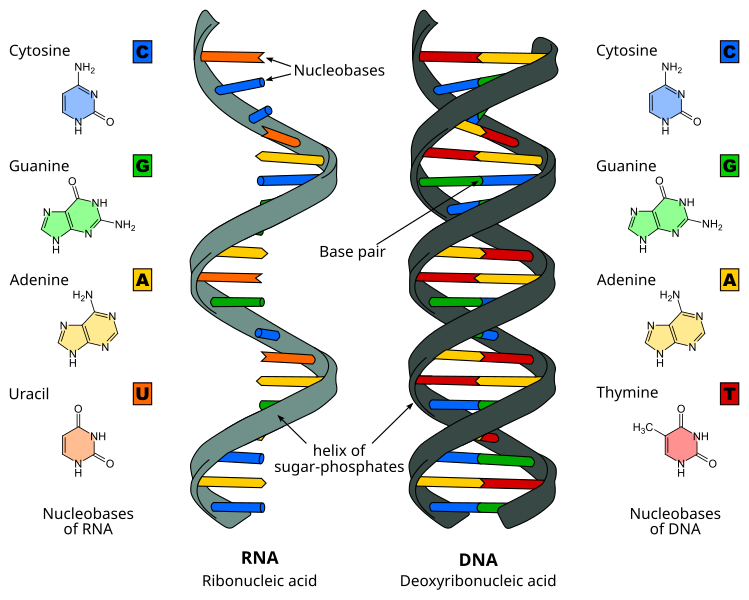
So all the information on how to make proteins is contained in DNA. This information is written as a string of 4 bases called adenine, thymine, guanine, and cytosine which are abbreviated to A, T, G and C.
RNA vs DNA
Now proteins are made up of stings of 22 possible amino acids, which are also abbreviated to single letters codes.
Amino acids and their 3 letter and 1 letter codes
So how does the 4 letter code of DNA get translated into a 22 letter code of proteins?
First off the DNA gets transcribed into RNA (which is like DNA but it is sometimes single stranded instead of double stranded like DNA, and secondly it has uracil (U) instead of thymine (T)).
To work out what protein sequence the RNA codes for you need to read it in groups of three bases. For example the sequence AUGGGAGGG would get split up into AUG GGA GGG. Each of these groups of three bases are called codons and each codon represents an amino acid. You can work out which amino acids a sequence codes for using the genetic code in this table.
The Genetic Code (click for a bigger version)
So AUG codes for M, GGA codes for G and GGG also codes for G.
In the genetic code table there are 25 letters (X is missing) so we can spell stuff out using codons instead of the full alphabet.
How we've got that sorted lets make the jewellery.
1) First decide what you want to spell out using the code. How about starting with your name?
2) Now figure out what codons you need to spell out your name.
So in my case I want to spell out 'Mark'. So I need the codons AUG GCG AGA AAA.
3) Next select the coloured beads that represent the bases. So AUG is blue, red, yellow. The GCG is yellow, green, yellow.
4) Finally thread the beads onto the string in that order. Tie it off and hey presto a bracelet with your name spelt out in the genetic code.
FAQs. Why are there more codons than amino acids?
There are 4 bases and codons consist of 3 bases. So that makes 64 possible codons. But there are only 22 amino acids (and in most organisms there are actually only 20). Which means that there are loads more codons than amino acids. This means that there are some spares, which turns out to be quite handy, because its suppresses the effects of mutations. For example, if ACC got mutated into ACG it wouldn't make any difference because they both code for the same amino acid. Why do some codons say 'STOP'?
Genes always end in a STOP codon. It signals the end of a protein, its sort of like the full stop at the end of a sentence. If you fancy it put a STOP at the end of your sequence.
Why do some STOPs have have U or O after them?
U and O are the two rare amino acids. Most organisms don't use them. But when they do crop up they code for U and O instead of STOP. How come some of the codons have two letters after them?
22 of the letters represent individual amino acids. Plus there's Z, B and J which are used for some of amino acids that are quite similar. So if a biochemist isn't sure if she's got a I or a L in her protein then she'll write down J. I've got an X in my name what do I do?
You'll have to cheat, maybe use one of the stop codons instead.
1) Sort the jelly babies into colours. Keep four of the groups and eat the rest.
2) Pair up the jelly babies so that one colour always goes with another. e.g. red with green and yellow with purple.
3) Stick the pairs onto a cocktail stick like you are making mini-jelly baby kebabs.
4) The attach the jelly baby kebabs to the long sweets. Carry on doing this until you have something that looks a bit like a ladder.
5) Pick up your ladder and give it a twist.
Hey presto a model of DNA made from sweets!
So what does it all mean?
DNA contains the information needed to build a living thing. That info is recorded in the form of four bases called adenine, thymine, guanine and cytosine (usually abbreviated to A,T,G and C). In my model each of the coloured jelly babies represent one of these bases. So lets say yellow is A, purple is T, green is G and red is C. In DNA the base T always pairs up opposite A, whilst C pairs with G. And to represent that I paired yellow with purple and green with red.
The DNA molecule then twists up to form a cork screw like (helical) shape, hence the twist I gave it at the end.
Our model of DNA represents just a tiny fragment of a real DNA molecule. In reality DNA could be billions of bases long (and I couldn't get hold of that many jelly babies).


 .


 (some supermarkets or hardware stores stock this, or get it online)
 (its used in cosmetics and tattoo inks so its harmless)


 some ready made putty (but where’s the fun in that). And besides if you make it yourself you can muck around with the PVA to water ratio to make it more or less runny. More water makes it more slime-like, more PVA makes for a firmer putty.


 .


